

By A.J. Weimer · Corporate pilot, 90+ countries
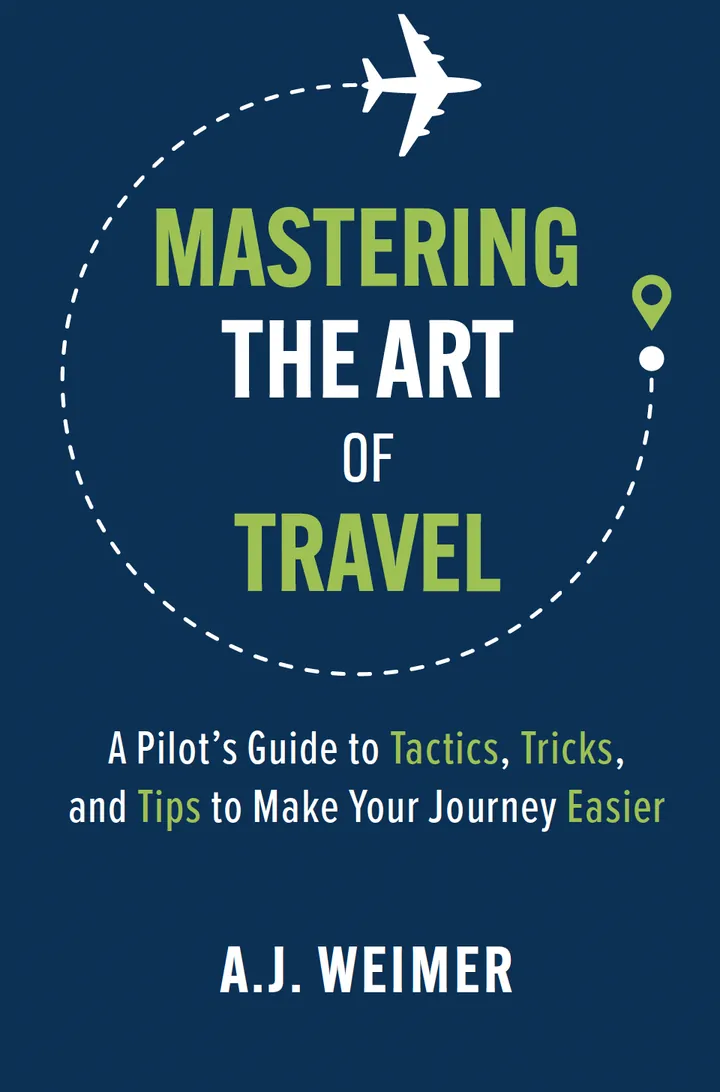
Mastering the Art of Travel
A pilot’s complete system for traveling safer, lighter and with less stress.
4.5 out of 5 on Amazon · “A gem of a guide for the traveler.” (Readers’ Favorite)
BookBaby Paperback or eBookBarnes & Noble eBookApple Books eBook
Paperback $19.95 · eBook $9.99
Buy a signed copy · Subscribers get 10% off
What you’ll learn
Research any destination
Threat levels, visas and what most travelers never check.
Pack light, miss nothing
A packing system that actually works.
Stay safe abroad
Real tactics from executive protection work.
Move through airports like a pilot
From booking to boarding, less time and stress.
Hotels done right
Choosing the room and the checks that could save your life.
Beat jet lag
Arrive ready to perform, not recover.
Read any culture fast
Adapt quickly without looking like a tourist.
Protect your home
The seven steps most travelers skip before leaving.
Holiday gift
Giving it as a gift?
Get a signed copy straight from me. Tell me who it’s for and I’ll sign it to them. Limited supply, shipping included.
Free sample · From Chapter 7
Read a free sample: The Art of Safety
Earlier in Chapter 7, A.J. lays out his Active Shooter Response (ASR): get off the “X,” assess and make a plan of action, then commit and act. In this section, he explains how he trains that response until it becomes automatic.
Threat Conditioning Training
As a pilot, I am always in a state of training. I train for emergencies—from human to aircraft—so I can respond in a logical and calm manner to maximize the decision-making process. For example, every six months I go to training for the aircraft I fly and practice losing an engine on takeoff. This prepares me to act normal, keep the aircraft under control, make a plan, and return back to the airport to land safely, no matter how bad my surroundings may be. Likewise, you too can train yourself for emergency scenarios by practicing what I call “Threat Conditioning Training” (TCT). This is proactive to help you be reactive during an assault. Again, this is not about being paranoid but rather being prepared. Over the years, I have trained my brain, so I no longer think about these things and instead have them wired into my subconscious. TCT involves training your mind to respond as quickly as a person can catch a ball. If a ball is thrown at you, most likely you will just catch it. What you won’t do is raise your arm and consciously think “okay, step 1, open my hand for step 2, then close my hand on the ball for step 3.” No, instead you just react to catching the ball. Why? Because you probably spent a lot of years throwing and catching a ball, developing a feel and the muscle memory needed to react instinctively. TCT does this for preparedness. TCT is practiced in three steps: Egress, Protection Areas, and People.
Keep reading the free sample
Egress
In aviation, we are always training emergencies and safety when an aircraft is on fire or crashes somewhere. Most big jet airplanes will have lights leading you to the exits. If something happens, we egress out of the plane and find safety. “Egress” means to physically remove yourself from a situation and seek safety by finding the exit. Anytime you enter a restaurant, movie theater, or a store, look for and locate the exits and ask yourself what you would do to egress from an active shooter. I am constantly identifying exits. Most who practice TCT continually would say to always identify two exits in case one is blocked.
Protection Areas
I use the term “protection areas” to identify what the military also calls “cover and concealment.” There’s a difference between the two. During an active shooter scenario, “cover” will protect you from those flying bullets, which means you need to choose items that are heavy and bulky that bullets cannot penetrate. This might be behind a car, a concrete pillar, or a barricade of some sort. Keep in mind that walls may appear to be good for cover, but they are not great protection areas, as bullets can easily pass through them. Conversely, “concealment” is the intention to hide from the shooter. This might be behind a curtain, a clothes rack if you are in a mall, or perhaps using other humans to blend in and disorient your attacker. Using a good protection area will give you both.
People
Use situational awareness to look for things that stand out. Picture Barcelona during the summertime. It’s hot out, and everyone is in shorts. You see a man walking with a winter coat, sweating, and looking nervous. Chances are good this is a bad guy. Trust your gut and create distance from him. Most importantly, notify the authorities. Observing people intentionally wherever you go is a great TCT approach to rewiring the brain to be alert.
It’s not about being the strongest when it comes to surviving an active shooter situation but instead having a good ASR. Sometimes it is just luck. However, your chances of survival increase by training and planning. Again, I’m not suggesting living life in fear or in a paranoid state all the time. It just means you plan for the worst and hope for the best. By TCT training you make a habit of having a plan to egress in the event of bad things happening. You start noticing protection areas with plenty of places for concealment and cover. Furthermore, you stand a better chance of identifying suspicious individuals and even perhaps preventing an attack simply by looking for things that seem out of place. There are two types of people in this world—those who are trained and those who are untrained. Which one will you be?
Surveillance Detection
Today we are faced with a barrage of criminal and terrorist activity all over our little planet. Kidnappings happen all the time. Terrorists can strike anywhere at any time to unsuspecting travelers. Pickpockets and criminals look for anyone who is not a local and strike when least expected. So how can we as travelers avoid these things before they happen? The reason I feel a conviction to educate others about surveillance detection is due to an incident that happened to me years ago, days after the September 11 attacks in New York, 2001. It was early afternoon, and the weather was cool outside with bright, blue skies. I was on a train headed down to Tokyo, which was about a forty-five-minute train ride from Fussa Station, located just outside Yokota Air Base. It felt different this time, as the events of 9/11 had everyone on edge. I can’t explain it, but it was there. The train was buzzing along, and the car was intensely quiet. If you have ever experienced the trains in Japan, you know it’s like nothing else you will experience in the world. Everyone keeps to themselves and the only noises you hear are the clanking of the tracks and the wind rushing by the cars. If you hear noises from people, usually they’re coming from foreigners. On this day, I was sitting at one end of the train car and happened to glance down to see a man, who was obviously not Japanese, staring back at me intently from the next car. Usually, I would not have given much attention to this, but since America had just been attacked by terrorists, I had my suspicions. The train stopped at a station just outside of Tokyo, and I got off to change trains. The man followed me. I was now on edge. I got on another train and went one stop in the opposite direction, changed trains again to another stop, and changed trains one more time. He followed each time. I knew this was it. I was definitely being followed. As a martial artist, I have learned that no fight is won on your heels. Offense, in most cases, is the best course of action. So I took my cellphone out and walked toward him while taking his photo with my phone. At the same time, I challenged him, asking why he was following me, and as soon as I started speaking . . . he ran. Even though Japanese phones didn’t have great color cameras at the time, I managed to get a decent picture of my follower.
The next day I returned to the military base and brought my photo of my alleged follower to the Office of Special Investigations (OSI) for the Air Force. The OSI is the FBI equivalent for the Air Force. The OSI special agent whom I spoke with revealed to me there were several terrorist cells living in the area, and they had all but vanished the day after 9/11 happened. The one following me happened to be one of them. Who knows if something would have happened, but the point is that being vigilant, proactive, and paying attention to the details perhaps saved my life. My time spent in the military and in executive protection taught me a lot about surveillance detection. This is also another subject entire books can be written on. However, for the sake of this book, I will focus on only those subjects in surveillance detection I feel are important enough to learn for the average traveler. These tactics are meant to be used as a means to counter kidnapping, counter terror, and avoid criminals. Keep in mind that all planned terrorist or criminal attacks begin with surveillance of the target. Therefore, if someone is watching, they are detectable.
From blending in and protecting your money to self-defense, active shooter response and spotting surveillance, Chapter 7 is a pilot's complete playbook for staying safe anywhere in the world. Get the full chapter in Mastering the Art of Travel.

Not a list of hacks. A system.
Travel is a skill. Like flying, it can be learned, practiced and mastered.
This is the playbook I wish I’d had on my first trip: built from aviation discipline, executive protection work and two decades of real-world travel.
- Your first international trip
- Frequent business travel
- Families and solo travelers

About the author
AJ Weimer
AJ Weimer is a corporate pilot, Gold Seal Flight Instructor, martial artist, military veteran, and founder of Nomad Pilot Life. His career spans international executive protection and more than 20 years flying jets around the world.

See travel through a pilot’s eyes.
BookBaby Paperback or eBookBarnes & Noble eBookApple Books eBook
Paperback $19.95 · eBook $9.99